False Dawn
Silence isn't complicity, and it is mad to think otherwise

Dawn French, then.
I think others elsewhere have covered exactly why the video she posted last week was so grossly unpleasant, so I don’t intend to dwell too long on why using a baby voice to refer to the October 7th massacre was disgustingly crass. Nor should it really need explaining in any case.
The apology followed shortly afterwards:
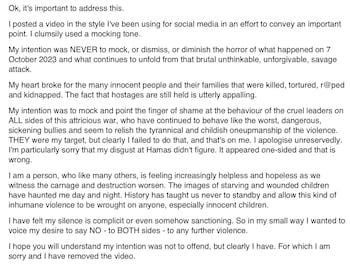
I just wanted to briefly touch upon part of the apology which jumped out at me, here, specifically:
“I have felt my silence is complicit or even somehow sanctioning.”
Now, other than French getting sanctioning and complicity the wrong way around, this is a fairly standard tenet of progressive activism, this idea that “silence is complicity”. It gets said so often that it barely raises an eyebrow most of the time.
But for some reason, reading French’s attempt at making amends, it struck me: what a completely crazy and egotistical thing to think.
Does Dawn French really feel that if she doesn’t say something about the conflict in Gaza, she is in some way responsible for whatever happens there? Why in the world would anyone think that? Does she imagine that her recent intervention has materially changed the realities of anything in the Middle East, at all? Dawn - none of this is your fault.
Does this complicity run across all issues, all of the time? Is everyone who has remained silent on, say, the war raging in Sudan - twelve million people displaced, 150,000 dead, reports of ethnic cleansing and mass sexual assault - culpable for those horrors to a degree? Nobody talks about that, or about the plight of Uyghurs in Xinjiang, or about the Rohingya in Myanmar. I don’t believe anyone who is yet to comment on those atrocities is therefore implicated, because that would be a mad thing to think.
It is completely understandable to feel moved when we see impossible suffering on a daily basis, of course it is. It would be inhuman to not find it all incredibly upsetting. It all makes us feel desperately helpless, and it engenders a feeling that one should do something.
Whilst I often think it is regrettable that we now must hear generally ill-informed political ramblings from celebrities, this is not an argument for staying silent. Nor am I arguing that if you speak out on one issue you must speak out on everything (though it does behove us to communicate in rather better ways than Dawn French did).
The argument here is that “silence is complicity” is a bad thing to tell people and a foolish thing to believe. It tells you that if you don’t speak out about some intolerable situation over which you have zero control, it is in some sense your fault. This is almost a quasi-religious requirement: repeat the mantra to wash your sin away. Suddenly nobody is paying any attention to Gaza, but what other people in the UK are saying about Gaza.
But then this is modern internet activism I suppose; individualistic and performative. The demand for people to “speak up” and the insistence that “silence is complicity” isn’t really carried out with any expectation that doing so will change anything. It’s a way of re-affirming fealty to the tribe and identifying the non-believers for vilification. To be blunt, did Dawn French post that video because she thought she could stop the killings in the Middle East (she felt that her silence was making her complicit, remember), or because she wanted to signal her beliefs to other social media users in the UK?
Three years ago, I wrote about how political activism was devouring everything, fracturing society into political silos which want nothing to do with one another, and why that is a bad thing, most of all for politics with a collective ethos. The demand for all of us to take a public stand on every issue (or, at least, on the issues activists affect to care about) is just another facet of this phenomenon.
Having politics shoved into every crevice of modern life is self-defeating but it is also utterly exhausting. Silence isn’t complicity as much as it is a recognition that the only thing speaking out really achieves is an increase in political discourse in everyday life; I remain convinced that what we need is the exact opposite.
Despite having made similar arguments about impact/responsibility a lot, I don't think this one stands scrutiny.
The issue isn't that "speaking up" is impactful but that it's *cheap*.
If we're going to talk about actions which will *definitely* have no (direct) effect, what about saying "The Holocaust was bad"?
It's the cheapest of "virtue signalling" (you know, next to every other human social behaviour) given that time travel doesn't exist and even if it did, what magic would the words do.
It's also a clear invasion of politics into normal life.
But does that make it *bad*?
Words *are* cheap - and that's a really great reason to use them!
Will people be crushed by moral admonitions to pay attention to the world and make minimal contributions like "Holocausts are bad"? Does it make sense to *not speak up* about atrocities you're aware of ... because there are others you're not aware of?
That's not a moral argument, that's just "don't attempt anything unless you can do it perfectly" straw man.
Somewhat off topic (normally I would message you bt am on a Twitter break): have you seen?
https://youtu.be/2aUaeOw6Q-c?si=zdqiaQMq4GCbB8AW